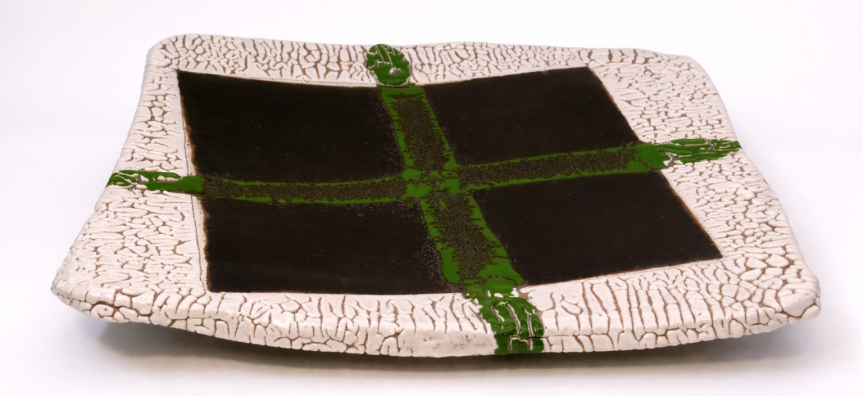
Chronos: Australian ceramics from 1933
Chronos approaches Australian ceramics through the lens of long time. Beginning in 1933 (the earliest ceramic piece in the MAG&M collection), the exhibition traces how ceramic practice contains and transmits decades of cultural change. Clay is presented not simply as a medium shaped in a moment, but as matter that frames time itself.
Drawing on the thinking of Australian theorist Elizabeth Grosz, ceramics can be understood as a way of giving form to duration, stabilising forces that are otherwise diffuse, slow, and difficult to grasp. Fired clay fixes time, even as it registers its passage.
Ceramics’ durability makes it a powerful carrier of cultural memory. Unlike more fragile media, ceramic objects persist, accumulating histories of use, display, neglect, and care. Across decades, shifts in technique and intent become legible, not as a linear story of progress, but as layered continuities. Older forms recur, decorative languages return, and hand processes endure alongside industrial and conceptual approaches. In this sense, ceramics operates as a slow medium, resistant to the art world’s fixation on speed, rupture, and novelty. Time is not surpassed but inhabited.
The exhibition design is central to this approach. Works are arranged in close proximity within the display, compressing years of practice into a shared field. Viewers are required to adjust their position in front of the case, leaning in, stepping back, and shifting laterally as relationships between works come into focus. Time is encountered spatially, through closeness and overlap, as well as a sequence to be followed.
As visitors navigate the exhibition, movement is slowed and looking becomes deliberate. The arrangement interrupts clear sightlines and asks for bodily adjustment, Chronos presents ceramics as a medium grounded in persistence, attention, and the long work of being held, seen, and cared for.
Gallery